
How should we understand a constructed ‘West’?

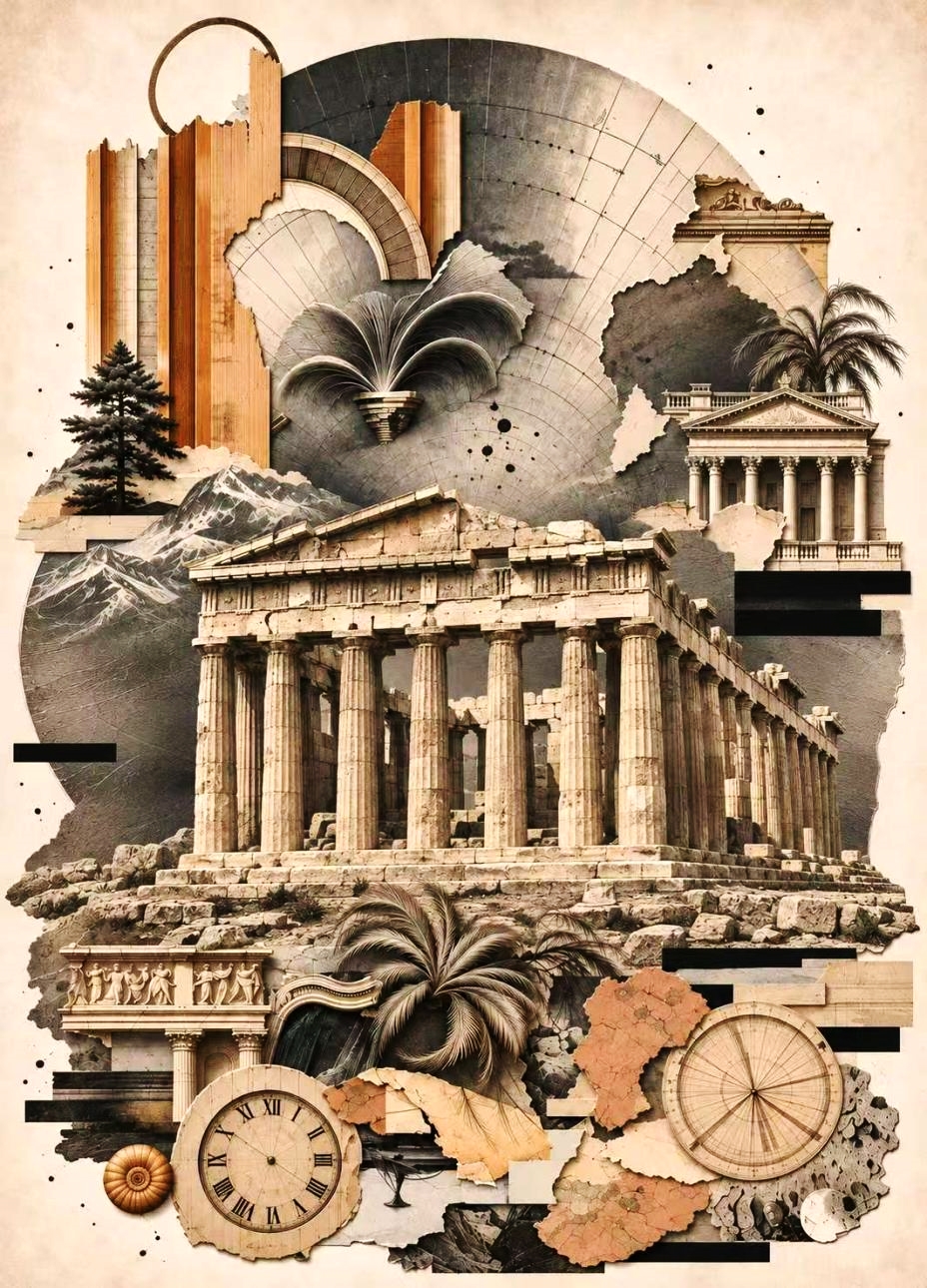
The relationship between ancient Greece and the modern West is more complicated than a straightforward line of descent. Image generated by AI
By YANG XUE and CHEN MIRONG
US Secretary of State Marco Rubio’s Oct. 7 speech in Athens revived a familiar question: What makes ancient Greece so enduringly influential? His answer emphasized ambition, exploration, invention, and glory. Yet ancient Greek thought and history offer a more complex picture—the pursuit of excellence coexisted with ideals of moderation and self-knowledge, and the celebration of heroic ambition went hand in hand with reflection on its dangers and limits.
To explore these complexities, CSST spoke with scholars of classical antiquity about the competing values within ancient Greek culture, how successive generations have interpreted and reshaped its legacy, and whether the history of Western civilization can be understood as a continuous line of descent from ancient Greece. Their perspectives reveal a classical inheritance shaped by continuity as well as by reinterpretation, historical ruptures, and exchanges across civilizations.
Tensions within Greek ideals
“Generally, any culture is complex and contains its own contradictions,” said Joel P. Christensen, provost and senior vice president for academic affairs at the Graduate Center of the City University of New York, where he is also a professor of Classics.
Early Greek ideas about competition, he explained, appear in Hesiod’s Works and Days. Hesiod distinguishes between two kinds of strife, one of which spurs people to excel through rivalry. But this spirit of competition was tempered by an equally strong concern about the dangers of excess and hubris.
Success, moreover, was understood as a matter of both luck and skill, and even hard-won achievements could be undone by fortune. Christensen pointed to Herodotus’ account of Solon’s visit to Croesus, in which Solon advises us to “count no man lucky until he’s dead,” because anything can be taken away. For Christensen, a celebration of Greek ambition that overlooks such warnings misses some of ancient Greece’s most important lessons.
“The Greece that Rubio celebrates has little room for the wisdom of Apollo’s Oracle at Delphi, whose most famous injunction was gnothi seauton—‘know thyself.’ Equally absent is the traditional Greek ethical maxim: ‘nothing in excess,’” Christensen said. “Self-knowledge and moderation stand at the heart of the Greek intellectual tradition.”
These principles also help explain why Greek literature often treats its heroes with such ambivalence. Christensen argued that the Iliad and the Odyssey, which helped shape later ideas about heroism, also dwell on its dangers. When Rubio praises thymos as “the fire of passion, strength, courage, pride,” Christensen said, he overlooks Achilles, the most famous example of unchecked passion in Greek literature. “The Iliad begins with his rage, and that rage brings catastrophe not only to his enemies but to his own people,” he added. “The poem is less a celebration of unrestrained greatness than a warning about the costs of excess.”
For Giorgio Piras, a full professor of classical philology from the Department of Ancient Sciences at Sapienza University of Rome, this diversity of perspectives is precisely what makes ancient Greek culture relevant today. “Ancient Greek culture offers actually a plurality of voices rather than a single hierarchy of values,” Piras said. “Competition and the pursuit of excellence were certainly important, but so were questions about what excellence meant, whom it benefited, and what limits should govern its pursuit.” Socrates’ habit of questioning what people took for granted, he observed, remains fundamental because “recognizing the limits of our understanding is a condition for meaningful dialogue.”
Ancient Greek values also changed over time as political communities and institutions developed. Ioannis E. Kotoulas, an adjunct lecturer in geopolitics at the University of Athens, described ancient Greek civilization as “a dynamic creation” that evolved as social ideals shifted from one era to the next.
How later generations remade the Greek legacy
“There is nothing wrong with looking to the ancient world for inspiration,” said Christensen. “But selective readings of antiquity become dangerous when they transform complex historical lessons into simple slogans.” In his view, the risk arises when modern societies look to ancient Greece for guidance and elevate certain achievements while overlooking the historical realities and competing values that gave them meaning.
Christensen cautioned against invoking ancient Greece to justify contemporary ambitions, pointing out that it was “a multicultural environment with different values and ideas in tension with one another.” Understanding its legacy, he said, means distinguishing between how the ancient Greeks understood their own traditions and artifacts and how later generations interpreted them and decided which to treat as canonical. Rome’s engagement with Greek culture offers a concrete example of how a civilization’s legacy can change as it passes from one society to another.
The Greek works that came to form the canon passed through particular languages, institutions, and teaching practices, all of which helped shape how those works were understood. As Piras observed, “Each generation receives an inheritance already shaped by earlier readers, then changes its significance through new questions.” The study of classical reception thus looks at ancient works alongside the readers whose interpretations helped give them their authority.
Ancient Greece and the making of the West
The relationship between ancient Greece and the modern West is more complicated than a straightforward line of descent. Christensen argues that the modern idea of the “West” is itself a product of historical construction. “The Greece that is central to this vision is as much a construct as any other story we tell about the past,” he said. In his view, what looks like a continuous inheritance reflects a history of appropriation and cultural memory rather than an unbroken transmission from antiquity.
The historical record reveals a more complicated picture. Alexander’s conquests reshaped the Greek world and the eastern Mediterranean. Rome later brought Greece under provincial rule while adopting and adapting its cultural and artistic traditions. This shift in political power did little to interrupt the transmission of Greek learning, which endured in the Eastern Roman Empire even after the Western Roman Empire fell. Christensen argues that the idealized image of Greece now associated with Western civilization took shape much later, particularly during the Renaissance.
Piras likewise cautions against projecting the modern idea of the West onto the ancient world, while emphasizing the depth of the historical connections. Texts, languages, educational practices, legal traditions, and philosophical debates link ancient Greece and Rome with Christian Europe and societies conventionally described as Western. Yet these connections form “a history of transformations, interruptions, and rediscoveries rather than a single, uninterrupted line.”
The question, then, is not whether ancient Greece influenced Europe, but how that influence was transmitted, transformed, and interpreted—and how the boundaries of the West itself came to be defined. Piras emphasizes that “‘The West’ is itself a historical category whose geographical boundaries and political meanings have changed.” Ancient Greeks and Romans did not understand themselves as members of the modern geopolitical entity bearing that name. To project that category onto antiquity, he warns, risks making a complicated history look like an inevitable line of descent.

Copyrightc©Social Sciences In China Press